
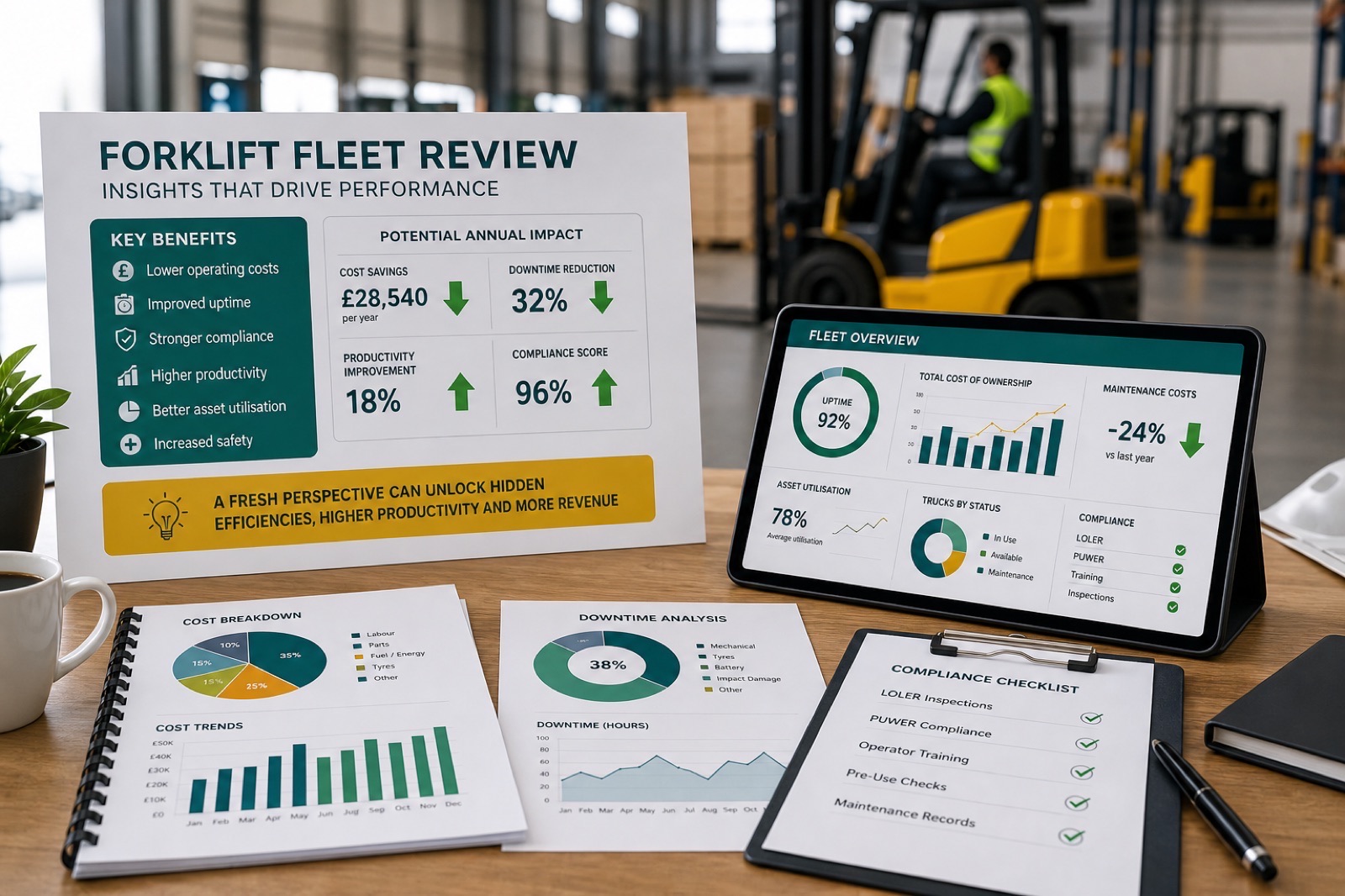
Understanding how to prioritise fleet actions matters because it can change availability, safety, cost or compliance in a real forklift operation. This guide explains the practical point a manager needs before forklift cost is reviewed as invoices rather than as a pattern created by utilisation, damage, downtime, tyres, batteries, hire and maintenance behaviour.
Short answer
Prioritise fleet actions is a practical forklift management issue: it changes what the truck can do, how confidently the site can use it and what evidence a manager should check before acting. For prioritise fleet actions, the cost question is whether avoidable spend, downtime, hire dependency or replacement pressure is being created. For prioritise fleet actions, the answer becomes operational when it is connected to repair cost against replacement timing, overtime created by delayed pallet movement and an observable sign such as missed pallet movements during the shift peak.
What this means in practice
Prioritise fleet actions affects the operation when the issue changes truck availability, route planning, operator confidence, repair timing or compliance evidence. For prioritise fleet actions, ask where it touches the working day rather than whether it sounds technical. For prioritise fleet actions, the cost question is whether avoidable spend, downtime, hire dependency or replacement pressure is being created. Managers reviewing prioritise fleet actions should be able to point to the observation, action and risk reduced. Reviewing prioritise fleet actions, the clearest evidence on prioritise fleet actions may appear at the decision point between another repair and planned replacement. For prioritise fleet actions, first observe the task during a normal busy period rather than an empty-site trial; then compare the latest observation with the previous three records. A reliable method for prioritise fleet actions states who checks, what they record and how the outcome is followed through. Include replacement delayed while repair spend accelerates in the comparison.
If prioritise fleet actions is handled loosely, managers can spend money without solving the real constraint, leave uncertainty in the records or keep a truck working in conditions that deserve a clearer decision. With prioritise fleet actions, the practical choice is to accept and monitor the condition, intervene now, or change the support or equipment route.
Key checks
- For prioritise fleet actions, identify which truck, route, load, shift or record is affected by prioritise fleet actions. Record its effect on overtime created by delayed pallet movement.
- Before prioritise fleet actions consumes time or budget, check whether the issue is occasional, repeatable or linked to a known peak in work. Connect the finding to underused capacity within the owned fleet.
- Using the decision point between another repair and planned replacement to test prioritise fleet actions, use service history, operator comments and inspection notes to separate fact from assumption. Show whether it changes tyre spend against surface and turning conditions.
- To make prioritise fleet actions site-specific, decide whether the next step is repair, training, hire cover, parts supply, LOLER action or equipment review. Use battery replacement against charging behaviour to judge its importance.
- For prioritise fleet actions, the person approving the next step should set an owner and review point so the conclusion becomes an action, not a note. Record its effect on repeat damage by truck, route and shift.
Common mistakes
For prioritise fleet actions, treating the issue as an isolated event can hide the influence of repair cost against replacement timing. Omitting evidence connected with tyre replacements concentrated on one route also prevents a reliable before-and-after comparison.
What good looks like
For prioritise fleet actions, the target state is a shared rule at the decision point between another repair and planned replacement, supported by evidence about repair cost against replacement timing, a named owner and records addressing overtime following truck availability losses.
When to ask WRMH for help
For prioritise fleet actions, involve WRMH when evidence from the decision point between another repair and planned replacement remains inconclusive, the sign returns or overtime created by delayed pallet movement changes the decision. For prioritise fleet actions, share the truck identity, task conditions, previous action and evidence connected with hire extensions hiding an unresolved repair. For prioritise fleet actions, that information helps WRMH target the relevant capability.