
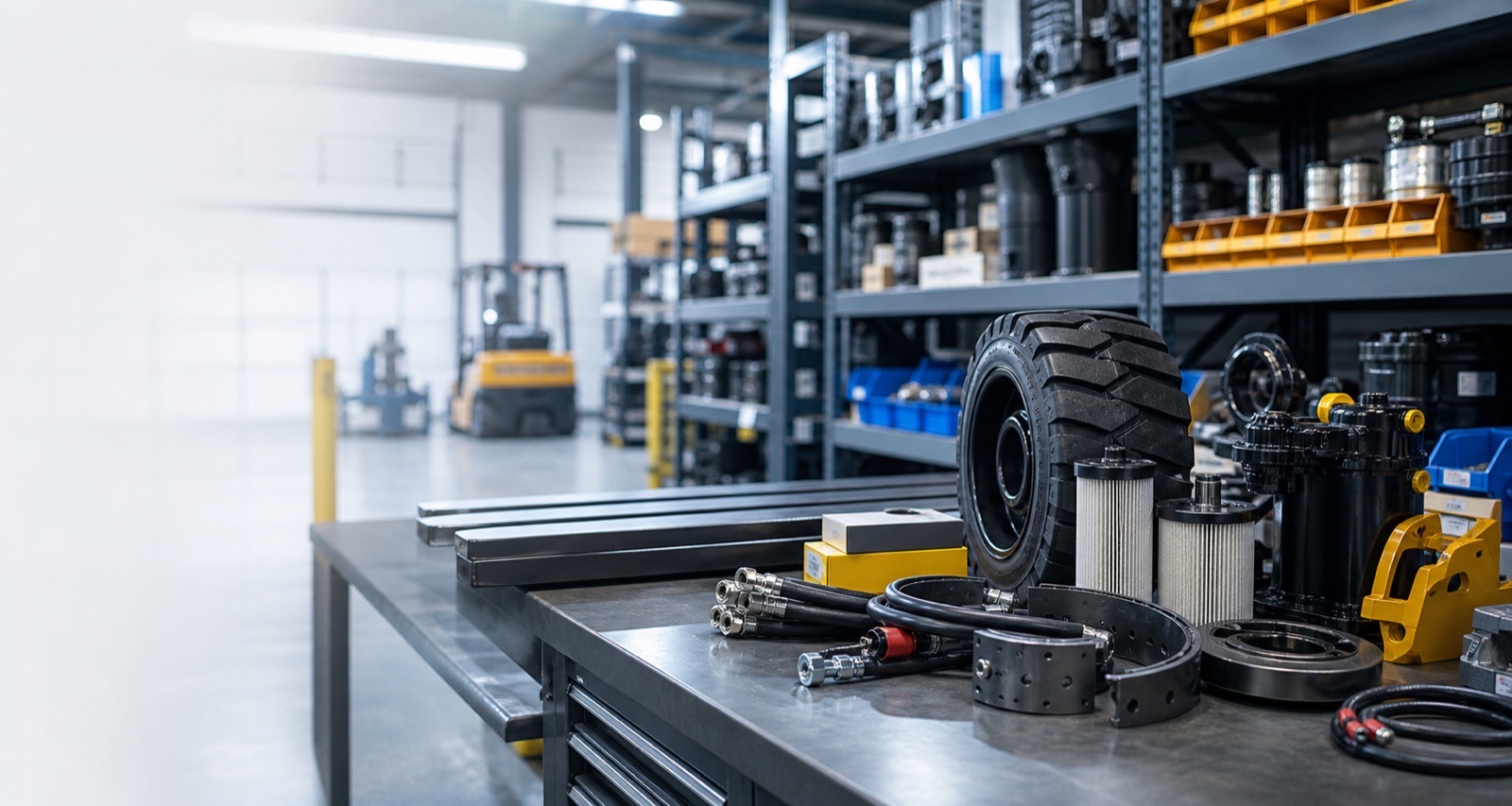
Part price matters, but it is not the only cost. A cheaper component can become expensive if it fits poorly, fails early, delays the repair, weakens warranty confidence or makes the engineer return to the same truck.
Short answer
The cheapest forklift part is only good value if it is correct, suitable quality, available when needed and supported by a clear warranty route. Managers should compare part quality against the truck role, safety importance, downtime cost and whether the part needs to last in a demanding application.
What this means in practice
A low-cost filter, wheel, hose, switch or brake component may be acceptable in one application and a poor choice in another. A truck working long shifts, carrying heavy loads or protecting dispatch needs a different risk view from a low-hour back-up truck. The cost of failure is not just another part; it is downtime, labour, lost confidence and possible safety exposure.
The manager decision is whether the price saving is meaningful after fitting time, repeat fault risk and lost availability are included. That is where quality, delivery and warranty need to be compared together.
Key checks
- Compare quality level, fit confidence and warranty, not price alone.
- Check whether the part is safety critical or hard to access once fitted.
- Consider the truck's role, hours and downtime consequence.
- Ask whether poor quality could create repeat attendance.
- Balance delivery speed against confidence in the part match.
Common mistakes
A common mistake is choosing the lowest price when the truck is critical to production or dispatch. The saving can disappear if the part causes a repeat visit or fails before the site has recovered the original downtime.
What good looks like
Good control means the manager can justify the part choice by quality, suitability, warranty, delivery and downtime risk, not only by the cheapest visible line on the quote.
When to ask WRMH for help
Ask WRMH for help when price differences are large or the part affects safety, uptime or warranty confidence. WRMH can compare quality options and help decide where value sits for that exact truck and application.
ask WRMH to compare part quality and downtime risk before choosing the lowest price.
Manager decision and evidence
The cheapest forklift part can be expensive twice affects the operation when the issue changes truck availability, route planning, operator confidence, repair timing or compliance evidence. For the cheapest forklift part can be expensive twice, ask where it touches the working day rather than whether it sounds technical. For the cheapest forklift part can be expensive twice, the parts question covers identification, quality, availability and the correct fitting route. For the cheapest forklift part can be expensive twice, managers should use site evidence rather than habit or assumption. Reviewing the cheapest forklift part can be expensive twice, use the serial-number check against the component removed from the truck as the practical test point: record the decision, owner and review date beside the original evidence, then compare the latest observation with the previous three records. A manager should be able to connect the sign to its likely cause before deciding the response to the cheapest forklift part can be expensive twice. Check the result against repeat failure around an unchanged routing problem.
If the cheapest forklift part can be expensive twice is handled loosely, managers can spend money without solving the real constraint, leave uncertainty in the records or keep a truck working in conditions that deserve a clearer decision. Evidence about the cheapest forklift part can be expensive twice should determine whether the action is operational control, technical repair, operator development, temporary cover or planned replacement. The manager should record who owns the action, what evidence will confirm it has worked and when the decision will be reviewed.
For the cheapest forklift part can be expensive twice, this extra discipline keeps a useful article from ending as general guidance. It gives operations, maintenance and safety teams one shared basis for deciding what changes now and what evidence should be retained.